<meta name='google-adsense-platform-account' content='ca-host-pub-1556223355139109'/> <meta name='google-adsense-platform-domain' content='blogspot.com'/> <!-- --><style type="text/css">@import url(https://www.blogger.com/static/v1/v-css/navbar/3334278262-classic.css); div.b-mobile {display:none;} </style> </head><body><script type="text/javascript"> function setAttributeOnload(object, attribute, val) { if(window.addEventListener) { window.addEventListener('load', function(){ object[attribute] = val; }, false); } else { window.attachEvent('onload', function(){ object[attribute] = val; }); } } </script> <div id="navbar-iframe-container"></div> <script type="text/javascript" src="https://apis.google.com/js/platform.js"></script> <script type="text/javascript"> gapi.load("gapi.iframes:gapi.iframes.style.bubble", function() { if (gapi.iframes && gapi.iframes.getContext) { gapi.iframes.getContext().openChild({ url: 'https://www.blogger.com/navbar/16736154?origin\x3dhttp://protheism.blogspot.com', where: document.getElementById("navbar-iframe-container"), id: "navbar-iframe" }); } }); </script>
3 comments | Monday, June 05, 2006

I recently downloaded G.K. Chesterton’s, Orthodoxy. The second section (II) is amusingly called “The Maniac.” While I was freshly beginning to read it, this piece jumped out at me:


[I]f the great reasoners are often maniacal, it is equally true that maniacs are commonly great reasoners….Every one who has had the misfortune to talk with people in the heart or on the edge of mental disorder, knows that their most sinister quality is a horrible clarity of detail; a connecting of one thing with another in a map more elaborate than a maze. If you argue with a madman, it is extremely probable that you will get the worst of it; for in many ways his mind moves all the quicker for not being delayed by the things that go with good judgment. He is not hampered by a sense of humor or by charity, or by the dumb certainties of experience. He is the more logical for losing certain sane affections. Indeed, the common phrase for insanity in this respect is a misleading one. The madman is not the man who has lost his reason. The madman is the man who has lost everything except his reason.


I can’t help but be of the same opinion with Chesterton. It’s no wonder that some of the most brilliant people are reclusive and can’t tie their shoes. It seems today that reason is put on such a high pedestal (sometimes even to idolatry) that all else is secondary and diminished by it. What Chesterton sees quite clearly is that reason cannot be virtuous in it of itself and those who operate by it and no other become exasperating to communicate with.

As Chesterton stated, “if you argue with a madman, it is extremely probable that you will get the worst of it”; because the madman does not take notice to the complementing features of humor, charity, experience etc…

I have just recently started to read this work, and I can already tell that it is going to be an excellent book. For those who are interested, you can actually download the book for free in pdf format here: G.K. Chesterton, Orthodoxy

Labels: , ,

10 comments | Monday, March 27, 2006

Every once and a while, an atheist makes more than an incorrect statement; they make a complete distortion of an issue. I came across on of these incidences recently on this post on abortion. I want to make a couple comments, and then link to some recent posts on abortion that will cover the topic more in depth.

From the Post:

“There is a dangerous cult in this country and around the world. This cult attracts not just the naive religious types, but also those who consider themselves to be critical thinkers. The cult is that of the "Fetus Worshipers".”
Notice the terminology of “dangerous” here. Who is it exactly that supports killing a living being and tearing it out of the womb in pieces? Also notice that if you attempt to preserve the unborn child you are now a cult “fetus worshipper”—more below.
“This cult lives under the delusion that early stages of embryonic human life are full grown human beings - living and breathing and due rights that no one else in our society hold.”
This statement is another distortion; in fact it’s a straw man. Nobody is claiming that the unborn are “full grown human beings.” They are human beings in the early stages of development, but still human beings. Apparently, according to this atheist, “nobody” in society holds that the unborn are human beings that deserve right (like not to be murdered), I guess all the debate that’s been going around has just been my imagination! Also notice that this assertion is made without the benefit of a supporting argument.
“Most of the members of this cult are religious, with some exceptions, and most are conservatives.”
What does this have to do with anything? Most arguments used by pro-life advocates are not ‘religious’ arguments. Just because someone may be “religious” does it automatically follow that they do not have the right to speak out on an issue?

“Most of the members of this cult are religious, with some exceptions, and most are conservatives.”
Again, there is no supporting argument for either the pro-choice position or any form of “worship” here; the author is just trying to poison the well against anyone who is pro-life. Secondly, we don’t “disdain” women’s rights. This another diversion tactic often used by the pro-choice advocate. If the child is a human being; then the mother does not have the “right” to murder the child—just as she doesn’t have the right to molest, or abuse the child. The “woman’s rights” argument only works if the child is not a human being—that’s the issue—nothing else.

“In the view of many fetus worshipers, the fetus has the right to take the life of a woman if it is inside her body. Rapists are encouraged by the fetus worshipers to impregnate women and form more glorious fetuses which a woman must carry within her body for nine months. It is a bizarre cult indeed.”
This is a bizarre argument indeed. Before I address this, all these statements are not the primary reason that abortion is legal; the author is bringing in severe cases that put a spin on the issue. Primarily (with some exceptions), abortions are performed due to the inconvenience of having a child—an absolute selfish ideal.

It’s my view that during the pregnancy of the woman, if a medical issue arises (even during birth) that threatens the life of the mother and a decision has to be made to either save the mother or the child; I say save the mother.

The author states that pro-life advocates encouraged rapists to impregnate women—this is the most idiotic statement I have ever heard; only a true unethical and immoral person would state that about the opposing position. Dealing with the rape issue can get lengthy because of the ordeal the woman has to go through—but, the bottom line is, we must ask ourselves if we would abort a two year old for the same reason. If a pro-choice argument doesn’t work fro aborting a two year old child, then it doesn’t work for the unborn child.

“The cult has the idea that premature human forms have desires and thoughts. They do not. They do not desire to be born. They do not desire to destroy their mother or endanger her life. They are not rational, thinking, fully formed humans. They are fetuses. Get it?”
It’s unlikely that the unborn have thoughts as we do; however, none of these listed attributes are possessed by new born children either—so according to the same logic, we can kill newborn children and legalize infanticide—eight month olds are not “rational, thinking, fully formed humans,”. Why don’t pro-choicers’ check their own logic?

“This cult is personal to me because most of my fundaMentalist family belongs to this cult. My sister, who is just over 40 years old, recently remarried and decided to try to have a second child. She knew the risks and made the decision to try anyway realizing that the odds were substantial that the pregnancy would not mature. She became pregnant, but after about 2 months began having complications. She prayed. She went to the doctor and was told that the fetus was dead. It was not alive. She was devastated. She was told that she would need to have the dead tissue which was this fetus removed in order to avoid serious health risks. But being a fetus worshiper, she could not bring herself to have it removed. She bled for over a week before the majority of the tissue exited her body. She could have died because she worshiped this fetus so much and believed, I suppose, that 'God' could somehow bring it back to life. Having the procedure was too much like having an abortion in her view. She would have rather died than have this dead tissue taken from her body. It makes me so angry and so sick. This fetus could have robbed me of my little sister.”

What does this have to do with abortion? If the child is dead then it’s not abortion to have is removed—her choice to let the child naturally exit her body is a personal choice she made. Nothing follows form this. I will say, though, that I’m sorry this happened to her.

“Here is my view on 'Fetus Worship'. If the fetus is so grand that it actually the right to prosecute an assault (look it up here) , then I say let it appear in court as a witness. Let it walk right out of that uterus and state it's views. Ridiculous you say? Isn't this what fetus worshipers believe?”

Ehhh, NO! Here is another attempt to distract from the issue. Can a (born) baby “appear in court as a witness” or “State it’s views” No? Oh, okay—then it’s okay to kill the baby right? This pro-choice case is, well, it’s stupid.

“That the fetus is a consciousness – a thinking human with as many rights as an actual living breathing person? If you want to save a fetus, then we will have aborted fetuses sent to you and you can have them put into YOUR body. Women who are denied to right to end a pregnancy and control their body will send you their unwanted children and YOU can raise them. Or the state can just send all of you fetus worshipers the bill for all the unwanted and uncared for children.”

This is another attempt to distraction from the issue. This is all the pro-choice people can do, because they have no argument; so they try to distract from the issue. Whether or not one could, or did take all the fetuses and put it in their body, foot the bills, or care for the children; it says nothing of the “rightness” or “wrongness” of abortion.

“So what does this have to do with atheism as atheism has no one view on the subject and obviously some atheists are as rabid anti-abortionists as the most idiotic believer? In my view, if you don't believe in the idea of a 'soul' and you understand basic biology, then you would have to understand that a fetus is not a fully formed human.”

Who’s the idiot here? Pro-life does not claim the fetuses are “fully formed”, but we do claim they are human. There is no such thing as partially human or fully human—just ‘HUMAN.’ And if you understand basic biology, then you would understand this.

“It is at it's essence a parasite of the host - its mother. It is what it is. It is not what it might become. It has no potential outside of its mother’s body.”
A parasite? Notice the missing supporting argument? That’s because this author just likes to make irrational assertions. It’s not a “potential” human being—it is a human being. Show me some biology that shows otherwise.

“ If you believe that 'God' is the only one who decides what life should live or die (unless of course he directs his followers to murder), then you would be inclined to have a child you might not want or to coerce or force a woman to bear an unwanted child.”

If you believe in rational coherent thought, and are a moral person, then you should not support the massacre of innocent unborn children and support infanticide with your pro-choice arguments.
“Also, if you are religious, you are taught that sex is bad.”
Wrong again. God created sex for married men and women; not for pass time fun from anyone that comes around—then use abortion as birth control.
“Pregnancy, for many, is the unintended result of sex. So to make sex less of a risk with birth control or even abortion is wrong. While I would not condone abortion as a first line means of birth control, it is odd that the anti-abortionists almost all oppose trying to prevent the pregnancies in the first place.”
What? I don’t know where this person gets his info, but he’s talking the wrong people.
“Growing up as little Baptist conservative, I was naturally a rabid anti-abortionist. I understand the naive views of those who worship the fetus because I have been one of them. I am glad that as an adult I have managed to care more for my fellow living and breathing human beings, my family and my wife, and worry less about all of the fetuses.”
I think it’s more accurate that the people who support the massacre of millions of unborn children every year are the dangerous cult members—The Cult of Fetus Murderers. It gets old hearing the same old week arguments by pro-choice advocates. Why don’t we stop the petty talk and discuss the real issue—Are the unborn human beings? The answer to this question will be the deciding factor in the issue.

Recommended reading:

The Illogic of "Pro-Choice"
The magnificent Wedge

Labels: , , , , ,

7 comments | Wednesday, March 01, 2006

The ‘Reluctant Atheist’ (RA) over at biblioblography has claimed to defeat the Watchmaker teleological argument. His approach; however, is somewhat dissimilar than the usual rebuttals offered by opponents. Also, he seems exceptionally confident that his argument points out a “huge” deficiency—which vanquishes the teleological argument.

In His confidence, he says:

I’m going to attempt to hamstring the damn thing (it’s only a concept, so I can be as brutal as I like), by pointing out a huge deficiency in the theory.
Okay, this should be interesting. RA has made a confident assertion here—Lets take a look at what RA has presented:

Creators are bound by the same laws as their creations.
This somewhat of a general statement; if were talking about a God (since “it’s only a concept”), we must make the distinction between natural creation, and supernatural creation. In natural creation we have man creating things such as houses, buildings etc (even animals such as birds can create nests). These creations start with preexistent materials and laws. Supernatural creation does not necessarily start with these confinements.

Following:

Bear with me here: I can keep this simple.

An architect needs design a building according to specifications. Read: laws of physics. More often than not, the building itself will go upwards. The shape of said building can vary widely, but it would be a foolish builder indeed, to hoist a skyscraper into the sky in the shape of a sail (especially in, say, Chicago, the windy city). It could be done, theoretically, but the cost would be enormous. There are of course other factors brought into consideration: cost, materials, foundation (location, location, location is apparently not restricted to retailers), earthquake safety regulations (in any area prone to such variables), etc.

But of course, the law of gravity comes first.

Everything about this example is certainly true; but RA, seems to fail to make the distinctions I made above and is equivocating natural and supernatural creation, the crux of the teleological argument

Now the core of RA’s argument:

The point here is simple enough: every watch made by a human is restricted by the same laws the creator of said device is prone to. Heat, leverage, gravity (have I mentioned gravity yet? Sorry), pressure, in short, long laundry lists of physical law. Oh, and of course, time.
There are a couple ways to approach this. First, we can point out the Christian attributes of God (can’t speak for other religions). We know that physical laws affect physical things. Given that God is not a physical ‘thing’ (so to speak)—there would not be a necessary affect on God. It can be formulated this way:

P1: The Laws of Physics affect Physical Things
P2: God is not a Physical Thing
C: Therefore, God is not affected by The Laws of Physics

Secondly, as I pointed out to RA, in his post, the laws of physics are contingent on the existence of the universe. For the sake of argument, if God created the universe, he is not contingent upon it—he would have existed prior to it (in order to create it); hence, before the laws of physics. Thus, if God existed prior to the beginning of the universe, He is not bound the laws of physics, which are contained only within the universe.

Continuing with RA’s argument:

If you throw the watchmaker and the watch off the Empire State building, not only will they fall at approximately the same rate, the end result will be remarkably similar on impact: the insides will go everywhere. One will be more liquid, but both will come apart at the seams.

Likewise, the creator will eventually wear out. As will the watch (though the latter may last somewhat longer, contingent on its design, how often it needs to be wound, when the battery wears out, etc).

I couldn’t help but express amusement at the above analogy. Really, go ahead and throw God off the Empire State building!. If you throw a bird off the roof it will fly away, how much more could God do? Anyway, my above refutations address this.

RA continues his argument against God with the “Where, then, is this mysterious stranger…” rant, but I’ll spare the digression since it’s an entirely different issue.

Of course, I pointed out the deficiency of RA’s argument, but he had some objections to what I had to say. Lets see:

Ah, I see: you thoroughly ignore the way things are, as opposed to your romantic notions. How...very typical. There had to be some structure, for this non-existent deity to build from: materials, a greater creator, a creator before that...infinite regression

…if we look at the example of the architect, the architect existed before the building, ergo, the builder isn't bound by the same laws as the building is? Sorry, sophistry doesn't get the kewpie doll.Who's next?
Who’s next? RA is over confident. Obviously RA does not understand what I was saying (I thought it was simple). To further explain, God can create 'ex nihilo', this is neither a philosophical or theological problem. Moreover, since God is “outside” the universe, ‘ergo’, He is eternal, hence there’s no problem of gods after god’s ad infinitum (categorical fallacy).

I also pointed out that the ‘universe had a beginning’ so, if God designed it, He’s not confined by it (He’s outside of it).

Following, RA tries to squirm out of his dilemma and makes a foolish mistake and says: “Most amusing. However, as far as anyone knows, matter has always existed.” In addition he adds his sardonic slogans to try to deflate my argument (never addressing it) throughout our exchange:

“Your argument is fairly non-existent, as far as I can tell. Subtract a deity, & you have nothing”

“Sorry, sophistry doesn't get the kewpie doll. Who's next”

“I'm reminded of all those Frankenstein movies & their clones: "You can't kill/harm your creator! I gave you life!" Dunno why it reminds me of that. It just does. & I apologize if you take issues w/my calling things the way I see them.”

“There's no real issue - there's no real god - we're just here. Get used to it”

“stop wasting people's time w/your claptrap”

“It’s here [the universe]. Stop trying to reverse the argument. Prove there's a god - conclusively , I might add. I'm not the 1 making ridiculous claims here.”

“Approach this argument by subtracting your deity, and the house of cards comes tumbling down. Please try to do better.”

“All my arguments are pared down to this: everything just is. You're the 1 doing the special pleading here.”

“You missed. God NEVER EXISTED”

“Hey, I'm not swimming in that ole river in Egypt. Need a towel?”

“I'm not answering your questions because very simply, I don't believe in a deity”

“Hey, I go by the Lockian dictum: reality is measured by the 5 senses. All else is guesswork.”

“I'm not sure I really care about your questions.”

“Hey, the post speaks for itself. Res ipsa loquitor” [Latin gives the full affect]

“I'm pretty much guessing now, but I'd put you in high school. Am I close?”
These are some great treasures for the “Atheist Tool Box” as my friend Jim Jordan documents. Of course, it’s difficult not to exchange smut for smut; so I may have slipped out a couple good ones.

Now, back to the universe (pun intended) RA says in response:

“Neither did I say the universe had no beginning - my EXACT words were matter. Until you can give me proof that matter DIDN'T exist prior (what did your sky daddy create it all out of, anyways), stop wasting people's time w/your claptrap.”
My response was that if matter is contained within the universe and the universe had a beginning then matter had a beginning; elementary logic. If your going to claim that matter was “always there” then your claiming the universe is “always there”.

RA doesn’t really want to fess up to his flawed argument; he retorts with:

"Unless you can give me CLEAR proof of an example where a creator stands OUTSIDE the laws of physics, w/o positing an unprovable deity. You've proven nothing."
So RA, wants me to prove God stands outside the universe (where I guess he completely ignored everything I have present thus far); however I cannot posit God. So RA wants me to do the following:

Prove A is outside of B
However, you cannot posit A

So I guess RA is asking for me do X and simultaneously refusing to let me do X.

At this point, RA makes the same mistakes over and over, he says: “If matter has always existed (until this can be proved otherwise, then perhaps the universe has always existed?” I have a niece in 8th grade that can tutor anyone who thinks the universe is stagnate.

The discussion ended fruitlessly; I suspected it would. RA, refused to support his claims and offered to surrender if, and only if A. I could provide empirical proof that there is indeed an entity that exists outside of the boundaries of natural (physical) law.B. Provide an example, real-world, where a creator exists independently from the same natural laws as the (designed) creation.

So, I guess I’m back to square 1—never mind!

Labels: , , , , , ,

4 comments | Saturday, February 11, 2006

In order to maintain a fruitful discussion when handling the problem of evil, several preliminary issues must be dealt with before one can effectively and honestly proceed. In this brief post, I will attempt to present these required clarifications. First, this is in no way and exhaustive attempt to address, or down play evil—if anything, this is for my own edification.


It’s pretty much a guarantee that some time during a conversation with a non-believer the “Evil exists; therefore, [the Christian] God cannot exist” objection will come up (or be thrown in your face). The objection can be genuine, but most of the time it’s used to dismiss whatever the current topic(s) that might be at hand.

In a slightly more formal formulation of this argument see below:

P1. If God exists, He is omniscient, omnipotent, and omnibenevolent.
P2. If God is omniscient, He knows when any evil is occurring (or about to occur).
P3. If God is omnibenevolent, he would want to prevent all evil.P
4. If God is omnipotent, he could prevent all evil.

P5. So, if God existed, there would be no evil. (P1-P4)
P6. There is evil in the world.
C. Therefore, God cannot exist. (P5,P6)

There are several different ways to formulate this objection, but this is generally (in my experience) how it is presented, although in presentation—not as formalized.

Logical Possibilities

The non-believers objection seems to demand the logical impossibility of the existence of both an omnibenevolent God and evil. However, I don’t know that there is a good reason to think this is logically impossible. In fact, there is a logical possibility that it is the case that both exist. So, unless it can be explicitly shown that it is logically impossible, the very plausibly of evil and a benevolent God existing defeats the logical inconsistency.

Logical Probabilities

Though it’s not necessarily logically impossible for both God and evil to exist, one could argue that it’s not probable. Consider all the gratuitous pain and suffering that occurs in the world; millions of books could be filled with horrid accounts of disgusting torture and unnecessary suffering. As one accumulates the examples of these hideous things, it is easy to see why they measure the evils they see as an overshadowing to the possible existence of an omnibenevolent God.

I can not explain exactly why God does what he does, or allows what he allows, for I am not in the mind of God. Moreover, it’s difficult to give an all encompassing answer to the objector, because I don’t know exactly what is being put in play. I can say, however, that if the factors of evil are being relatively compared to the flavor of a good tasty bagel; surely the probability of God’s omnibenevolent existence will plummet. I am not saying that this is what is being done, I am just showing that depending of the variables that are in play; it will have a significant effect of the results of ones analysis.

Insofar as all the factors for the probability for Gods existence are appropriately applied, and compared to evil, one can confidently see that Gods existence is more probable than not—even when evil is taken into account (perhaps in the future, I can dedicate a complete blog post to this effect). When it is claimed that evil perils the probability of Gods existence, it can be asked, “What is evil relatively measure up to?”

Riddle Me This:

Without actually distinguishing between moral and natural evil, notice that P2 presumes that evil exists: “He knows when any evil is occurring.” This premise (along with P6) will only work if some objective form of “evil” actually exists. Bringing out this point can help isolate the issue. The best way to do this, it seems to me, is to ask a simple question:

(A) Is something evil because you say it’s evil? Or (B) Do you say something is evil because it IS evil?

The question is actually familiar to Christians, and often used (in one formulation or another) as a rejoinder to Gods moral nature (Euthyphro Dilemma). Nevertheless, the question helps get to the central point I want to discuss.

Evil is what I say it is:

Consider question (A) If something is evil because on says it’s evil; then it’s a matter of mere opinion. Question (A) makes evil a human convention that does not transcend the individual; thus, under question (A), evil does not exist. Therefore, P6 is effectively defeated if (A) is the standpoint. There’s really no way out of it; the argument against God due to evil only works if there is such thing as real objective “evil.”

It’s Evil for all people, all times, and all places:

This now leaves us with the latter, proposition (B): Do you say something is evil because it IS evil?

If (B) is true then evil is objective—or external to the individual; otherwise your stuck with proposition (A). Now, if evil can be identified as objective, a problem arises for the objector. Specifically, if evil is objective, then we must to give an account of its source. Insofar as we believe that real objective evil exists, we therefore have good grounds for believing that God exists. In fact, the very objection presupposes Gods existence.
Consider the following syllogism:

1. P presupposes Q
2. P
3. Therefore, Q

Or, we can also present this as logically equivalent to the following:
1. If P, then Q.
2. P
3. Therefore, Q.

Some will deviate from the propositions, or attempt to evade the question I pose by pointing out that the problem of evil is an internal inconsistency with Christianity itself, rather than a problem of their own (the objector). This is fine; however, the objector will have to effectively concede that the objection raised has nothing to do with their own dismissal of Gods existence, or has anything to do with their personal experience of evil in their own lives; because evil does not exist. However, even the charge of internal inconsistency fails to discredit Christianity, let alone the existence of God.

While one raises a problem of logical incoherence, or internal inconsistency they inadvertently argue for what they are arguing against. There is nothing internally inconsistent theologically with the “problem” of evil. However, it is not my intent in this post to argue for the theological consistency of Christianity and the way we observe the world today—including observations of evil.

Conclusion

I have attempted to point out that (1) The existence of both evil and an omnibenevolent God is logically plausible (2) The existence of evil does not necessarily surmount the probability of an omnibenevolent God (3) If evil is subjective the argument is immaterial (4) If evil is objective the objector has to give an account of it (5) There is no internal inconsistency with Christianity and the existence of evil.

In closure, the argument from evil can only be relevant if is meaningful, and it can only be meaningful if there is such thing as evil. What does this do for objector? It creates a dilemma—one that must be honestly examined. Though this could be much more developed, going through these key points is absolutely necessary to having a meaningful discussion about evil. There is really only one way to solve the problem of evil; we must stop trying to have God justify himself to us; but try to have ourselves justified before God. There is only one way to do this—through the Cross.

Labels: , , , ,

9 comments | Saturday, January 28, 2006

After recently having some discussion about R.W. Emerson with some fellow Christians, it became evident that there were some questions about his philosophy that went undetected. I pointed out some transcendental ideas of Emerson, but just got the “you’re from Mars” look. I remember Emerson’s writings well from high school, but have not come across transcendental philosophy in a while. In light of my recent conversations, I have decided to spew out some thoughts about Emerson’s philosophy and how it diverges from Christian Theology in the nature of God, man, scripture and morality:

To many, Ralph Waldo Emerson’s writings are cherished. Among those who admire and take pleasure in Emerson’s writings are committed and faithful Christians. To those who enjoy his writings, Emerson serves as an inspiration and a release to the confinement of rationalism, empiricism, and the social conformities of our day. Given the steadfast attraction to Emerson’s writings in the Christian community, how should Christians approach Emerson?

Christians must approach Emerson with extreme caution. Many elements of Emerson’s writings are not only contrary to traditional Christian theology, they are anti-Christian and polluted with heresy.

The Unitarian

Ralph Waldo Emerson began his roots as a heretic in the Unitarian Church. Soon after his pastoral beginnings, Emerson turned on organized religion. However, his new transcendental philosophy was a radical divergence from any Christian teachings.

Before I actually address some of Emerson’s more popular teachings, I want to first say a couple things about Unitarianism.

Unitarianism denies that the God of Christianity can be identified as the three-person Trinity (the Father, the Son, and the Holy Spirit). Unitarians believe Christ to be of immense significance, but not divine as traditional Christians hold. Rather, Unitarians believe that Christ had a “divine mission” to make people more aware of God’s righteousness and of our responsibility to care for each other. Thus, they are not Trinitarian, but Unitarian (God is one being/person).

As it can be seen, Emerson had already been subject and exposed to unbiblical and heretical teachings. Thus, with the Unitarian setting, it can be seen why Emerson could diverge from Christianity so easily and so intensely. Emerson’s Unitarian history sets the preface for what I want to pos about—specifically, Emerson’s anti-Christian transcendental philosophy.

The Transcendental Deity

In his essay The Over-Soul, Emerson described the transcendental deity: “We see the world piece by piece, as the sun, the moon, the animal, the tree; but the whole, of which these are shining parts, is the Soul.” Instead of a Christian deity, Emerson believed in the Over-Soul, a pervasive, pantheistic energy source rousing all things. For Emerson, the Over-Soul is the definitive reality of our world.

In comparison with Christianity, there are several irreconcilable discrepancies with Emerson’s Over-soul. First, God possesses the characteristics of being a personal spirit being. The personal attributes of God are infiltrated throughout scripture. For example: He lives (John 5:26), He loves (John 3:16; Rom. 5:6-11), He speaks (Matt. 3:17), He works (John 5:17, 20), He knows (Matt. 6:8, 32), He wills (Matt. 7:21), and He sees (Matt. 6:4, 6, 18). Thus, the Christian God is a personal being rather than an impersonal energy force.

The Nature of Man

Emerson’s view of man is also contrary to the tradition teachings of scripture. In fact, Emerson articulated an essential oneness of man with the divine in his essay The Over-Soul:

We know that all spiritual being is in man. . . [A]s there is no screen or ceiling between our heads and the infinite heavens, so there is no bar or wall in the soul, where man, the effect, ceases, and God, the cause, begins. The walls are taken away. We lie open on one side to the deeps of spiritual nature, to the attributes of God.
The elevation of man in this passage is precarious. How Emerson makes this connection is unknown. However, it seems that he claims to be a part of God; making himself divine.

Additionally, in his essay Nature, Emerson again clearly attributes divinity to man:

In the woods, we return to reason and faith. There I feel that nothing can befall me in life,—no disgrace, no calamity (leaving me my eyes), which nature cannot repair. Standing on the bare ground,—my head bathed by the blithe air and uplifted into infinite space,—all mean egotism vanishes. I become a transparent eyeball; I am nothing; I see all; the currents of the Universal Being circulate through me; I am part or parcel of God.
There are many things that can be said about this statement, but the last sentence is daunting. It’s as though Emerson is not only claiming to become united with nature, but become a part (in nature) of God. Nevertheless, Christian theology does speak differently on the nature of man. In fact, the only sense of divineness in man is in the image man was created—Gods image (Gen. 1:26; 5:1; 9:6; James 3:9; 1 Cor. 11:7).

Dismissing All Authority

Emerson also had issues with authority. He relied more upon the self for knowledge and wisdom. Emerson rejected the authority of scripture and Jesus all together in the Over-Soul when he stated:

Faith that stands on authority is not faith. The reliance on authority measures the decline of religion, the withdrawal of the soul. The position men have given to Jesus, now for many centuries of history, is a position of authority.
According to Emerson, Jesus must not be an authority, because if we trust Jesus as an authority, we begin to withdraw from the soul. In effect—Emerson’s scripture IS his soul. Moreover, with the soul being a pervasive, pantheistic energy source rousing all things; that too becomes his scripture and authority.

In the Christian world view, Scripture is not taken unconscientiously as just another book. The sixty six books collected and preserved as the bible is considered The Word of God to Christians. However, it is not the word of God merely because Christians call it that. The authority of scripture is derived from its unique and intrinsic nature of God communicating to man. In addition, the writers of the NT make clear that scripture is intended to be identified as inspired:

From childhood you have known the sacred writings which are able to give you the wisdom that leads to salvation through faith which is in Christ Jesus. All Scripture is inspired by God and profitable for teaching, for reproof, for correction, for training in righteousness; that the man of God may be adequate, equipped for every good work Timothy (3:15-17)
In addition to the Bible claiming authority, Christianity is often referred to as the religion of the book. Without giving a complete treatise on the authority and inspiration on the bible, let it be stated that Christianity bases all doctrines, believes and values based on what the scriptures say. The word of God gives Christians the revelation needed to fulfill Gods will; thus, all other sources of revelation (i.e. nature) are incomplete.

Morality

Emerson also deviated from Christianity by theorizing that one learns about truth and morality not from outer sources, but from the Soul inside oneself. In Emerson’s system, a man could instinctively perceive nearly everything he needed to know by trusting the divinity within. Thus, Emerson makes morality and truth completely subjective and arbitrary; morality springs from the Over-Soul. In his essay Nature, Emerson says, “All things are moral; and in their boundless changes have an unceasing reference to spiritual nature.” This over emphasis on the souls connect with nature, is what determines morality. Yet as all people know—nature can also be cruel. In Christianity, morality is absolute; not because God says what is good; but goodness emanates from Gods character. Emerson’s system of morality leaves no room for Gods goodness or man’s sin nature. With his keenness on purity, Emerson saw only the high, noble nature of man.

If one is to accept Emerson’s Over-Soul as ultimate reality, one discards absolute truth, thus, falls into the trap of moral relativism. With no absolute standard outside of Emerson (or oneself), people are free to contrive whatever the “intuition” may inform; questions of morality become issues of personal preference, just like choosing ice cream. Providentially, many Christians recognize that right and wrong are rooted in the unchanging character and nature of God. God is eternally unchanged and so are the absolutes of right and wrong. However, God has given general revelation in nature (Ps. 19:1-6; Rom. 1:19-20), as well as special revelation in Scripture (Rom. 2:18; 3:2; 2 Tim. 3:16-17), but since he is the author of both, there is complete harmony between the two.

In a sense, however, Emerson’s appeal to intuition cannot be totally discounted by the Christian, For "when Gentiles, who do not have the law [of Moses], do by nature things required by the law, they are a law for themselves, even though they do not have the law, since they show the requirements of the law written in their hearts..." (Rom. 2:14-15). Thus, Christians ought to apply accuracy in their analysis of Emerson’s moral philosophy.

It is clear that Emerson’s writings are heresy. Emerson’s philosophical divergences from Christian Theology has been exemplified in the nature of God, man, scripture and morality; the very essence of Christianity.

As the question was presented earlier, how should Christians approach Emerson? As Christians, God commands us in Scripture to “test all things; hold fast what is good” (1 Thessalonians 5:21). There are many well intended Christians with a desire to be spiritual; and Emerson’s writings have a strong spiritual flavor. Unfortunately, many of these Christians, like the ones I have been speaking with find Emerson and trust him. Whatever he says becomes not just inquiry, but dependent upon for spiritual truth.

Before one gets discouraged, Christians are permitted to read and enjoy the writings of Emerson and any other writer—lest we deprive our minds in an impenetrable bubble of isolation. Yet, we must be as those in Berea, who searched the Scriptures daily, to see if what they were hearing was true to God's Word (Acts 17:11).

As for Emerson, we were warned by both John and Peter of false teachers; even Jesus said they [false teachers] may come to us in sheep's clothing (Matt. 7:15; 1 Jn. 4:1; 2 Pet. 2:1). For the Christian, there is one body of truthful instruction that governs all that is believed, taught and practiced. That is, the Word of God. To live according to Gods word, nothing should be accepted as true; nothing should be practiced or recommended – unless it is tested in the light of scripture. Each individual Christian must take this obligation seriously when indulging in the philosophies of man.

Emerson is, and will always be, a celebrated heretic. His transcendental philosophy and Christianity are mutually exclusive and should be read with caution, lest one falls pray to his heresies.

Labels: , , ,

0 comments | Tuesday, January 10, 2006

Over at The Evangelical Atheist, I AM has posted an argument against TAG. I have never really been a strong proponent of TAG, simply because I have read about it, but never thoroughly used it. I have heard some criticisms of TAG by well known Christian philosophers such as Geisler and Habermass. However, I don’t think I have given enough study of the critics to totally discount the TAG argument.

With that said, I think I AM failed to give an adequate rebuttal of TAG. Additionally, through the comment section, there is some obvious confusion about TAG. I suspect that TAG has not been given its fair shake because I AM gave a “nutshell” synopsis of TAG consisting of only a few lines (though he did link to wikipedia).

I AM gives the following argument against TAG:

The transcendental theist apologist claims that we only have logic on which to rely because it was provided for us by god. In laying out this case, the apologist is accepting the validity of logic by trying to construct an argument. However, in stating that logic is the creation of god, it is implied that god would not be bound by logic. In other words, logic is contained within god instead of the other way around. Therefore, based on this assumption, it is impossible to prove the existence of god through logic. If god is bound by logic, and was preceded by it, then there is no need for him to explain its presence and necessity.

In my response to I AM’s refutation to TAG, I made the following claim:

Logic is neither higher than God nor arbitrarily commanded by God. Logic is grounded in God’s eternal nature. God is necessarily a rational God.

This statement shows that attributing logic as either superior of arbitrary of God will not refute TAG because it is neither.

I AM’s second line of argument against TAG is the following:

Similarly, in studying the universe, we must accept that there are laws of nature. Without that assumption, it is pointless to try to understand anything at all from a scientific perspective. […] First of all, this “reducibility” is based on our scientific observations of nature. So, as with the logical argument, if we take the laws of nature as creations of god, then we can’t use them to make any kind of statements about him because he would not be bound thereby. However, if the laws of nature are bigger than god or bind him, then we have no need for him to explain them.


Furthermore, if we use laws of nature in any kind of argument about god, we accept that said laws exist. Scientific laws are laws. If there is an exception, then we have the laws wrong. So, if there are laws, then nothing can occur outside them. This precludes miracles. It takes god’s omnipotence and makes him no more powerful than any other particle in the universe. As with any given electron, he must follow the rules, and he is therefore impotent if he exists at all. Does that sound like a god to you?

There is a lot packed in here, but clarification is needed. I asked I AM:
Are you arguing for an *absolute* uniformity of nature? It’s
not clear in your post.
I never did get an answer, but I ask this question because I don’t think that his second objection necessarily follows. Furthermore, I don’t think anyone has give an adequate account of it (epistemologically) within the Atheist worldview. For example, take what Greg Bahnsen has to say about giving and adequate account of our presuppositions:

Because all autonomous perspectives take man's interpretation of the world to be "original" - to be the primary ordering of particulars or "rationalizing" (making systematic sense out of) the brute facts, it puts man at the center of the knowing process - and pays the price for doing so by slipping in subjectivism and skepticism ultimately (when consistent and driven to the logical outcome of his presuppositions). The only alternative - the Christian worldview - places the creative and providential activity of the Triune God "back of" all of man's experiences and intellectual efforts, thereby solving the fundamental problems of epistemology which leave the unbelieving critic nowhere to stand. Only Christianity can account for or make sense of the intellectual accomplishments of the unbeliever. The critic of the faith has been secretly presupposing the truth of the faith even as he argues against it; his own arguments would be, upon analysis, meaningless unless they were wrong and Christian theism were true.

It appears that given the Atheist worldview, one cannot satisfactorily account for our presuppositions (reason, certainty, universals, cause, substance, being, or purpose, counting, coherence, unity, or system in experience or in a conception of a "universe," logic, uniformity, etc). Atheism cannot account for them because in their world view, there is nothing *higher* than man. Thus, if there is nothing higher than man, then there is no justification for our presuppositions— there aren’t any better than ones subjective opinion. Furthermore, once one posits a universe that has contingency at its very root (i.e. the big bang lottery), how can a universally valid law fit at all?


Following, my comments to I AM, a commenter attempted to refute my objection. He states:

Either we look at what god does, and see that it is rational, by some independent criteria - in which case we have an independent criteria of rationality that cannot be explained through resort to god. Or else we say that since god is doing it, it’s necessarily rational - in which case we have no way of knowing what’s rational or not, and it is indeed at god’s whim.

The statement that ‘god is necessarily a rational god’, like ‘god’s commands are necessarily good’, is not actually a third option in the dilemma. It is simply the starting point which the dilemma makes untenable, restated.

In response, I stated the following:

God could not do anything irrational because it would violate his nature. For example, he cannot make a square circle. This is why I said God is necessarily rational because we can not possibly picture a universe with logical contradictions.

If you want to call “Euthyphro shenanigans” on my objection, then you will have to demonstrate that logic cannot be an essential part of Gods character […] Perhaps you should try and turn the dilemma on yourself and see what happens…

What the commenter will find out is that he cannot justify his presuppositions.

The commenter continues with additional objections; however, his argument does not demonstrate that logic cannot have its source in God, but rather the argument itself precludes any notion of God from the outset. Whatever the case, It seems the commenter wants to maintain that logic cannot be contingent or in any way dependent on anything. I assume that this leads to the notion that if logic is dependent, then it is possible that it be changed. And if it is possible that logic be changed, then, God could make the law of non-contradiction false! But again, this is why I say God is *necessarily* rational.

As for the rest of the comments that posted after my departure, their conclusion(s) only states explicitly what has been implicit all along. It provides no rationale for the position attempted. That’s all I want to hear: a justification to these presuppositions with the exclusion of God.

I have never actually used the transcendental argument myself, simply because I have never had the opportunity. However, the post by I AM and the interaction in his comments have helped me to better appreciate TAG. Nevertheless, I don’t think I am ready to die on a hill over it just yet or at least until I have studied it more.

Labels: , , ,

0 comments | Friday, November 11, 2005

Greg Koukl has written a noteworthy argument for the existence of God through the reality of evil. The existence of evil has probably been the most difficult obstacle in my personal belief. However, the existence of evil is not a good argument against the existence of God. I hear this argument by atheists frequently.

Below is a taste of what Greg writes about in the article:

The argument against God based on the problem of evil can only be raised if some form of moral objectivism is true. Morals, therefore, exist. I need not give a complete taxonomy of ethical guidelines to make my case. If there is even one moral absolute, it invites the question, "What kind of world view explains the existence of this moral rule?"
I think this brings challenges to not just atheists but to theists. If evil exists—God exits. However, which world view has the best explanation for this? I side with Christianity, but Christians have a lot “splannen” to do with some of the things in the OT and historical events in the world. Nevertheless, I think it can be done, but there is no “silver bullet” for the problem of evil (though I wish there was).

Labels: ,

6 comments | Monday, October 10, 2005


When it comes to religious matters, most people want to be politically correct. That is, they want to say “all religions are equally valid,” which is religious pluralism. However, the only thing correct about religious pluralism is that it’s politically correct. Apparently, as long as you’re sincere about your religion, and just as long as some type of “god” is relevant somehow, it doesn’t really matter what you believe. Religious belief has been completely taken out of the realm of reality. This, however, is completely absurd. One does not even need be religious to see that this is completely false.

Greg Koukl deciphers the misunderstanding when it comes to religious truths. In an Article called “Religious Stew,” he says the following:

Forgive me for stating something so obvious, but there is a difference between choosing an ice cream flavor and choosing a medicine. When choosing ice cream, you choose what you like. When choosing medicine, you have to choose what heals.

Many people think of God like they think of ice cream, not like they think of insulin. In other words, they choose religious views according to their tastes, not according to what is true. The question of truth hardly even comes up in the conversation.

More than that, the question of truth is somewhat of a confusing, almost incoherent issue to them. How can you test something like a religious claim to determine if it's true or not? Religious truth is what you believe. It's that leap of faith you take. It has nothing to do with reality, ultimately. It is not anything you can test or measure. It is something you have to believe and hope against hope that it's true. It becomes a kind of wishful thinking, a religious placebo of sorts.

Clearly, many people choose their religion like they choose their ice cream; what ever you like. But religious truth is not necessarily likeable. In Christianity, there are some things I don’t like, and if it were up to me I might change them; but its not. I did not choose Christianity because I like it and it makes me happy, I chose it because I think it’s actually true.

On the one hand, religious freedom is a good thing. People should be able to decide what religion they want to adopt, or to even scrap religion all together—this is freedom. Tolerance is a virtue, and with all the diversity in America, we should be respectful to others. However, “tolerance” does not mean that “all views are correct,” it just means that we respect the person’s right to choose their religion. People have taken tolerance too far and have redefined it. It is defined in a way now that makes someone “intolerant” if they say any particular view is right or wrong; which in effect, is intolerant of those who are intolerant.

Going back to pluralism, we simply do not put religion in a world that corresponds to reality. However, religious claims can be tested for coherence—and either accepted or rejected based on the findings. The real question people should be asking is whether or not (fill in the blank) religion is really true. This is not an “ice cream” question. If a certain religion is true, your eternal destiny maybe at stake; being silly and choosing what’s good for you is just wrong. So, as Koukl suggests, the question of religious truth is more like a medication question.

To make more sense of this, let’s consider the Avian Flu. Suppose this flu suddenly became highly contagious and began to pass from human to human as some suggest. Here is something the media, government, and health officials will NOT tell you. They won’t say: “There is a huge outbreak of the Avian flu, everyone needs to immediately get the Avian vaccination; what ever that means to you.” This, simply put, is not a matter of what you like; it’s a matter of what will save your life. Parallel this with religious truth and you can see that it’s not a flavor issue. This is why religious claims must be tested for coherence.

Another tendency is when people pick and choose things they like from each religion and then make their own. This is another dangerous flavor tactic. Koukl has cleverly labeled this “Stew” in his article:

I call this idea religious stew--taking little bits and pieces of different religions and putting them together in one 'pious porridge,' so to speak--the eclectic view, the religious smorgasbord view, where you go down the line and pick a little here and a little there, and you put it on your plate and call it your religion. When you put things on your plate you put them there for a reason. You put things on the plate in a smorgasbord because they are the things you like, not necessarily things that are good for you. That is the same problem with the religious stew approach.

I find it strange when people pick their religion like a grand buffet. However, many justify this by asserting the similarities of the world’s religions are all that truly matters. But sound reasoning tells us, however, that all religions are not essentially the same merely because they contain some similarities. It only takes a brief survey of a few religions that would hastily reveal that every single one of them has competing claims which contradict other religions.

Take Hinduism for example; can someone logically square the Hindu teaching that the universe is God with the Muslim belief that Allah, the God of Islam, is distinct from the universe? Anybody who takes an honest approach to comparative religion would have to admit that religions harbor irreconcilable differences, demonstrating that they cannot all possibly lead to the same God. Logically speaking, it would be more correct to say they can all be wrong. However, they cannot all be right. The law of contradiction states that no statement can be both true and false; or, A and not-A is a contradiction and always false.

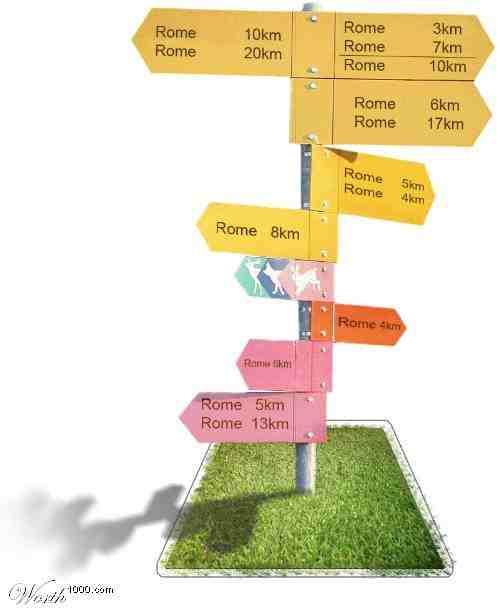
It is not my intent to condemn all religions, at this point; I only want to show what is clear. It is impossible for all roads to lead to Rome. In light of logic, we can still respect people’s freedom of choice, but let us not patronize each other with smiles ad nauseam as if it were—that all religious views are true. Everyone thinks their religion is the right one or else what’s the point? Their all exclusive. We should search for truth and reject what is not truth even in religious matters.


Labels: , ,

6 comments | Wednesday, October 05, 2005


During Socrates dialogue with Euthyphro, Socrates presented a confounding question to Euthyphro; a question which perplexed Euthyphro. This infamous question has deliberately been used to make Christians stumble and scrounging for an answer without being plunged into the horns of the two options; and for the most part, it has worked. Plato, a historical master thinker, wrote about Socrates in his dialogues. Frankly; we only know of Socrates through Plato’s writings and he may have very well been a figment of Plato’s imagination, but even so, the very real question still lingers today.

So what is this mortifying question posed by Socrates? Here is the quote:

The point which I should first wish to understand is whether the pious or holy is beloved by the gods because it is holy or holy because it is beloved of the gods.

In other words, Euthyphro’s Dilemma consists of asking: Does God (or [gods] in the context) love things because they are good, or are they good because God loves them? This is a simple question, but to answer leads to grave problems for the Christian.

A short way of asking this question is, “where do moral standards come from?” However, either answer to the question posed by Socrates plunges the theist (more specifically—the Christian) into a horn.

Here is a simplistic formalization of the argument from the Strong Atheism site.
1. Either:


(a) The Good is willed by God because it is the Good.
(b) The Good is the Good because it is willed by God.

1. If (1a) is true, then the Good is independent of God’s will.
2. If (2) is true, then God did not create the Good, and is not Creator.
3. If (1b) is true, then the Good is contingent and subjective (toGod’s will).
4. If (4) is true, then there is no objective standard of morality, and the absolute of value-selection is false.
5. [Therefore] God does not exist.

As one can detect, there is somewhat of a dilemma that Eithyphro faces. Or is there? An atheist and British philosopher, Bertrand Russell, devised the problem this way in his polemic against the Christian faith in, Why I Am Not a Christian:

If you are quite sure there is a difference between right and wrong, you are then in this situation: Is that difference due to God's fiat or is it not? If it is due to God's fiat, then for God Himself there is no difference between right and wrong, and it is no longer a significant statement to say that God is good. If you are going to say, as theologians do, that God is good, you must then say that right and wrong have some meaning which is independent of God's fiat, because God's fiats are good and not good independently of the mere fact that he made them. If you are going to say that, you will then have to say that it is not only through God that right and wrong came into being, but that they are in their essence logically anterior to God

When Russell is using this question, he is attempting to show a defect in the way Christians present God’s goodness. But the way the question is asked; one is forced to only take the two options. This is where the problem comes in. If “good” is good only because God says so, the goodness, therefore, has no meaning — God could take what is “evil” today and pronounce it “good” tomorrow, if He chose. On the other hand, if God has no control over what is “good” or “evil” in and of Himself, but is rather, inferior to some standard outside His control, can He actually qualify as an almighty and sovereign God? If there is a definition of “good” God can’t change, who wrote it?

Avoiding the Horns and solving the problem:

Socrates leaves us with only two options; however, there is a third. First, as Christians, we must reject both the first and second options (listed below) offered by Socrates to remain coherent:

1. Either:

(a) The Good is willed by God because it is the Good.

(b) The Good is the Good because it is willed by God.

In Islam; the “good” is the good because it is willed by God. Thus, the “good” is contingent and subjective (to God’s will) (1b) of the dilemma. Therefore, anything morally wrong today (i.e. torturing babies), is subject to change if God decides it is good. In other words, the God of Islam (Allah) is capricious. However, the God of the Bible is good by nature, and therefore, cannot fall in the horn of the second answer (1b), without being incoherent. But God is not good simply because He IS good (Good = God); He is good because it’s an essential characteristic of God, which leads to our solution.


Our third option (which is not offered by Socrates) is that objective moral law exists internally to God. In other words, the goodness of God is grounded in the absolute character of God; it’s in his makeup. Therefore, God could not arbitrarily make killing babies moral, because it would conflict with his character.

Dr. William Lane Craig condenses a precise answer to the dilemma as follows:

You split the horns of the dilemma by saying that the good is the very nature of God and that the commands of God flow necessarily out of His moral nature. Because God is just, He commands things that are for us just. So the good is neither arbitrary, nor is it something outside and above God. Rather the good is the moral nature of God Himself, which is expressed necessarily in His moral commands, which become for us our moral duties.

Solving the problem Euthyphro faced does not prove a Christian world view. However, it does show that Christianity is not surmounted with incoherence by this question. So, Euthyphro’s dilemma is really no dilemma at all; thus, it is a false dilemma

Moral Law Requires a Law Giver

Many Atheists reject absolute moral law because they recognize that, Atheism simply does not have the foundations for objective moral values and duties. If God does not exist, objective moral values and duties do not exist.

Again, Dr. William Lane Craig makes the argument exceedingly simple:

Actions like rape, cruelty, and child abuse aren’t just socially unacceptable behavior; they're moral abominations. Some things are objectively wrong. Similarly love, equality, and self-sacrifice are really good. Accordingly, we can affirm:


1. Objective values and duties require a Law Giver.

2. Objective values and duties do exist.

But then it follows logically and inescapably that:

3. Therefore, God exists.

Therefore, if you are an atheist, and you believe in absolute moral standards; you have a serious problem, because you simply have nothing to ground yourself with.

Labels: , ,

5 comments | Friday, September 30, 2005

Am I just a material being?—composed simply of a body, a brain, and a central nervous system—or is there something more to me? This is an important question. The soul is a necessary quality of the living human entity. Without the soul, a person isn’t a person; they are just a lump of meat. The soul is the quality that gives one personhood.

So, what exactly is the Soul? The soul is the immaterial “you.” Some of you may be wonder if there is any evidence of such a thing as a “soul.” Let’s take a look.

Evidences for the Soul

Dualism
One thing to note is that if we are only composed of physical properties, when the body dies, we die. The assertion that there is no difference between the mind and the brain, and that chemical reactions and physical processes is all that goes on in the brain—is physicalism. In other words, consciousness is a mere property of the brain. It is produced by the brain and is dependent on the brain.

However, if “dualism” is the accurate representation, then we have both bodies and a soul. To put it this way, in dualism, there is an immaterial you and it cannot be tested with scientific tools. You can’t put the soul into a test tube and measure it. The soul, gives the body life and houses the body, but not in a local way, because it is immaterial.

According to scientific studies, all the matter in your body changes (I think it was somewhere around every 7-9 years) at the atomic level, these changes include your brain. I know that I have physically changed drastically within the past decade (probably not for the better). However, if we are just physical and nothing else that means I am not the same “me” I was and I am a different person. First thought, crazy. Of course I am the same person. If we conceded to physicalism, we can reject many of our common sense ideas. Take for example your baby pictures. If you change every decade, your baby pictures are not really you; the person in the picture has a different body than you do.

Yesterday, I just signed up for a 401K at work (and a mighty reasonable one at that). But if I am only physical, and I know I am going to change, why bother with the 401K? I bother, because I know I will still be me, even though my body changes. This is only possible if there is something that remains the same throughout your whole life, not something material, but immaterial. The soul.

Some of you may be thinking that we have no scientific evidence that there is a soul. Therefore there is no soul. We can’t open anything physical about you like the brain and find the soul. If we cannot sense it, then why should we believe it exists?

Science is insufficient

Science by its very nature can't disprove a soul's existence because science deals with the physical and is not equipped to measure the non-physical.

Greg Koukl comments on the “scientific position” to address the soul. He says,

Science doesn’t tell us everything we know; in some cases, we must trust our reason. For example, in mathematical knowledge, we rely on evidence of reason based on certain universal mathematical principles, which are not empirical.
This is what I hear when people try to say there is no scientific evidence for the soul: “You said there was an invisible man in your house, but I went inside, looked everywhere, and I couldn’t find him.” Clearly, empirical evidence is ineffectual when looking for the soul. Therefore, any objection of the existence of the soul due to lack of empirical science only states there is no “physical evidence."

The correspondence relationship

As evidence for physicalism, it is often pointed out that for every so-called mental event, a corresponding change in brain activity can be demonstrated. From this it follows, it is said, that physical and mental events are the same-that is, what appear to be mental entities are simply physical entities (that is, physical properties, events, and substances)--and thus dualism is false.
If dualism is true there is a connection between brain (the physical organ in our heads) activity and mental activity (the activity of our souls). But connection is not identity. As J.P Moreland says, "...just because A causes B (or vice versa), or just because A and B are constantly correlated with each other, that does not mean that A is identical to B"

So the correlation between brain activity and mental events can be easily accounted for by recognizing that the mental and physical interact with one another and so influence one another. Thus, what happens in the physical brain influences and is reflected in the non-physical soul; likewise, what happens in the non-physical soul influences and is reflected in the physical brain. If the brain or physical body becomes limited (brain injury), so shall the soul be limited to have connectivity. For example, alcohol and drugs cause chemical reactions to the brain, thus hindering the soul’s ability to “connect” to the physical. But connection is not identity. The precise methodological relationship and function of interaction between the body and soul is unknown. But what follows from that? It certainly does not discount the existence of the soul.

Introspection

Nobody argues that we have no conciseness. Secondly, through introspection and self examination, we know about our own internal mental states. Most of our internal states are self-evident. But is a consciousness just complex physical state of the brain? No.

Philosopher Thomas Nagel makes this quite clear:
It is not a far stretch at all to suppose that bats are conscious. Suppose someone had perfect physiological knowledge of bats. It would follow, then, that if consciousness were merely a complex physical state, then that person would know exactly what it would be like to be a bat. However, it seems clear that all the knowledge in the world about bats could not tell someone what it is like to be a bat.

Objective facts are accessible to anyone. Consciousness is not accessible to anyone but the individual person. If we were merely physical beings, conciseness should be accessible to anyone. However, this is not the case; therefore, it is clear that the “mind” is not physical.

The Freedom of Choice and Determinism

It‘s clear from our awareness of our choices that we have free wills to do and act in any way we choose. We can choose to have pizza with pepperoni, or sausage (or both) these choices seem quite undetermined. When it comes to physical states, they are determined by other physical states, governed by physical laws. If it is the case that our minds are simply physical states, then we are not free. All of our decisions are determined.

Take a moment and think of all the choices you have made in your life. Your choices make you into the person you are. Why should you accept that the decisions you make are simply random events that you had no control over? A purely physicalist worldview limits us to this quandary. So, therefore, if you don’t believe in the soul, it’s because you are predetermined not to, and if you do it’s because you were determined to. So, if all are decisions are predetermined, any view you hold is not a result of reasoning. If this is the case, what are we quarreling about? We can’t choose our beliefs anyway, and to try to persuade—would be futile. Our free will choices make us unique and give us identity.

Near Death Experiences

There is another area of evidence that must be considered--Near Death Experiences (NDE). Roll your eyes if you want, but there is an interesting phenomenon that is valid. But I am not talking of just subjective experiences that can neither be proved nor disproved; I am talking about verifiable statements.

Dr. Raymond Moody documents some of these facts. Here are three verifiable examples recorded by Moody:

Example 1:

An elderly woman had been blind since childhood. But, during her NDE, the woman had regained her sight and she was able to accurately describe the instruments and techniques used during the resuscitation her body. After the woman was revived, she reported the details to her doctor. She was able to tell her doctor who came in and out, what they said, what they wore, what they did, all of which was true. Her doctor then referred the woman to Moody who he knew was doing research at the time on NDEs.


Example 2:

One patient told Moody, “After it was all over the doctor told me that I had a really bad time, and I said, ‘Yeah, I know.’ He said, ‘Well, how do you know?’ and I said, ‘I can tell you everything that happened.’ He didn’t believe me, so I told him the whole story, from the time I stopped breathing until the time I was kind of coming around. He was really shocked to know that I knew everything that had happened. He didn’t know quite what to say, but he came in several times to ask me different things about it.”


Example 3:

In another instance a woman with a heart condition was dying at the same time that her sister was in a diabetic coma in another part of the same hospital. The subject reported having a conversation with her sister as both of them hovered near the ceiling watching the medical team work on her body below. When the woman awoke, she told the doctor that her sister had died while her own resuscitation was taking place. The doctor denied it, but when she insisted, he had a nurse check on it. The sister had, in fact, died during the time in question


There are many more examples that could be shown. If these experiences were only firing neurons or physical dispositions, how did they know and describe the things that they did? There are far too many documented cases to write it off as a hoax. These experiences could only take place if you are not your body.

Who Cares?

I do have a soul; what are the implications for the decisions I make today? The amount of time you are on earth (even if you live 100 years), compared to eternity, is incomprehensible. When you die, your deeds will be evaluated against the purpose for which you were originally created. Many people already evaluate themselves; others evaluate them this way also. But it is your creator to which the final reckoning must be given, the one who "began" you. It’s worth investing your time and effort to investigate and secure you eternity. This is why one should care about the soul.

Hebrews 9:27: "And as it is appointed unto men once to die, but after this the judgment"

Romans 14:12: "So then every one of us shall give account of himself to God."

Labels: ,

10 comments | Wednesday, September 28, 2005

While blog hopping, I came across Nick Woomer's blog, an atheist lawyer who wrote “Disconnect in the abortion debate”. Interestingly, he gave a well written defense of the pro-choice movement and pointed out the central argument of the issue—namely: Is the zygote, embryo, or fetus a moral person? According to Woomer—No. Although I may be out of my league (trying to contend with a lawyer), in this blog, I will try to articulate and address his argument.

Let me a blunt as possible. If the zygote or embryo or fetus is not a human being (this includes personhood), no justification for abortion is required and pro-lifers might as well fold. However, if it is a human being, no justification for taking his or her life is adequate. This single issue is adequate to cover contingencies on both sides of the question.

Woomer argues his position (pro-choice) in the following way:

Now, there are plenty of obvious and relevant differences between a fetus and a young child: language; a normative outlook; mutual recognition of other persons by, and of, the child; complex emotions, etc. The pro-life argument can, and must be, addressed on its actual merits.

…human beings do seem to have a particular set of properties that distinguish us from other animals: language, a "conscious life," value systems, plans for the future, the ability to grasp metaphors, etc. What makes us special, then, isn't mere biological human-ness, but a cluster of uniquely human qualities.

True, embryos and fetuses are less developed than you and I. But why is this relevant? Woomer's argument asserts, although the embryo or zygote is a “biological” human, the fetus has none of the aforementioned capabilities; it cannot be a person with rights. But why should anyone accept the idea that there can be such a thing as a human being that is not a person?

If Woomer is correct about the distinction between human being and human person, he fails to adequately tell us why a person must possess self-awareness and consciousness, or other listed qualities in order to qualify as fully human. In other words, he merely asserts that these traits are necessary for personhood but never says why these alleged value-giving properties are value-giving in the first place, other than an insufficient differentiation between animals.

Even Woomer concedes the epistemological uncertainty of what makes human beings “special.” He says:

Why are human beings special? Why do we regard ourselves (rightly or wrongly) as superior to other creatures? The answer can't be determined with any certitude

If the immediate capacity for the listed qualities makes one valuable as a subject of rights, and newborns like fetuses lack that immediate capacity, it follows that fetuses and newborns are both disqualified. You can’t draw an arbitrary line at birth that spares newborns. Hence, infanticide, like abortion, is morally permissible. However, Woomer rejects this notion of infanticide in his post, “Infanticide is still wrong (Disconnect in the abortion debate, part 2)”, and argues that there are still good reasons to keep infanticide illegal.

Woomer gives an E.T. analogy and argues that E.T. is lovable because of his human like qualities. E.T. has the cluster of uniquely human qualities that allow us to identify with him and gain an emotional attachment; this is why it is so sad when E.T. dies in the movie. I am not sure, however, what this has to do with infanticide, since the infant (according to Woomer), does not have the human qualities.

This E.T. analogy can go either way. Take for example the movie, “Where the red fern grows”. The movie was about dogs, but yet, during the movie, many people develop an emotional attachment and they cry their eyes out. It does not follow; however, that the dogs were entitled to full moral personhood.

Woomer also argues that if biological humanness was determinative of moral personhood, then it would be morally permissible to treat E.T.-like beings like any other animal. Since this is hypothetical, it seems premature and morally ambiguous to immediately deduce this principal. There is a strong lack of data in this hypothetical analogy, such as E.T.’s origin and/or theological framework.

In his E.T. argument, he indicates that E.T. has the human qualities that attracts us too him; but according to Woomer, the infant (at least in early stages) does not posses his outlined human properties. Therefore, as suggested previously, the argument does not apply.

When does the cluster of uniquely human properties arise? The property, in which Woomer has listed, as he concedes, is definitely AFTER birth. However, he argues that infanticide is still wrong and would “brutalize” our culture. But why? If human value is based on properties as Woomer has purported, there should be no quarrels on infanticide. However, this is not the case; people on both sides of the abortion debate can intuitively know that infanticide is wrong; regardless of properties outlined by Woomer.

Woomer also stated the following:

The motivation to legalize infanticide would be rooted in an unwillingness to devote economic resources to the care of unwanted neonates. To put it lightly, it would be beyond crass to kill a biological human that will soon become a moral person just because we'd have to increase taxes to care for it. [Emphasis added]


Again, I would argue, why is this wrong? If this biological human does not have “personhood”, and the cluster of uniquely human qualities is not there, there should not be the conviction that the infant “ought” not to be harmed. However, the convicting intuition is there. Woomer argues against this point by asserting an “unspoken intuition” that neonates really aren't moral persons. He exemplifies this by showing the grieving difference between the death of neonates and toddlers.

The argument asserts that when a neonate dies, the focus is on the mother, and when a toddler dies, the focus is on the child. This argument is far too week. There will clearly be more grieving for a toddler than a neonate. First, this has nothing to do with personhood. It seems self-evident that the toddler would be grieved more (especially as individual), than the neonate because of the built relationship between the child and people around him or her. The emotional attachment that builds after birth is the factor; not whether uniquely human qualities are being developed.

This emotional factor not only applies to humans, but animals too. For example, there would be a clear difference between grieving for a dog you had only one day, or one that you grew up with. The grieving would have nothing to do with the dogs unique K-9 attributes that made it lovable; it would be the built relationship.

Secondly, there are emotive intuitions about neonates. Take for example pictures of aborted neonates. The pictures bring out emotion; even tears. Bluntly, these pictures are disturbing, even for pro-choice activists. These emotive responses are derived from a different intuition; the intuition that this neonate is a child—a person.

Philosophically, I argue there is no morally significant difference between the embryo you once were and the adult you are today. Differences of size, level of development, environment, and degree of dependency are not relevant in the way that Raleigh needs them to be. In addition, his philosophy untimely leads to infanticide, which; he denies as immoral. His collective argument for infanticide rests on the moral intuition that it is wrong to murder an infant; even though the infant does not possess the unique human qualities he has outlined. This example shows that personhood is not derived of the properties Woomer has given.

The pro-choice enterprise in any of its forms is doomed to fail because it ultimately reduces human value to functional terms. Humans have value simply because they are human, not because of some acquired property that they may gain or lose during their lifetimes.

A line in the sand

There is also another dimension to this argument. This dimension is difference in worldview. The majority (not all) of pro-lifers have a Judeo-Christian worldview (including myself). Thus, we hold the belief that people are created in the image of God, and thus is an answer to the question: What makes us special? This argument is predominately ignored in the public square; nevertheless, it develops the foundation framework of the pro-life argument.

In conclusion, which ever worldview prevails (Judeo-Christian vs. Secular) will determine the future of this and other significant (Homosexuality, Embryonic stem cell research etc…) debates.

Labels: , , , ,

2 comments | Thursday, September 22, 2005


There are a few popular books going around about some new “discoveries” in the brain. Purportedly, our faith is wired into our Genes. I have my suspicions about this hypotheses and how they reach their conclusions. Nevertheless, some Christians might be getting scared that this assertion might be true, and it is the only reason we may have faith.

Rest assured; there is nothing to fear. Even if it is true that some people are wired to faith (although I do not necessarily agree), it makes no difference. Let me save you tiring library research. The bottom line is this: regardless if we are wired for faith or not, it tells us nothing about whether or not the claims of Christ are really true. In other words, the validity of Biblical texts and the historicity of Christ are either true or false regardless of how you are wired.

For this reason, I take no “stress” to the “God Gene” hypothesis.

Labels: , , ,